.

.

Saturday, August 29, 2015

Alternative Medicine—the power of choice

Alternative medicine encompasses everything from homeopathy to herbal therapy, acupuncture to massage. To me, alternative or complementary medicine is anything that keeps my body well and on the road to balanced healing. Not to denigrate modern medicine, but many drugs that are commonplace today can actually cause imbalances and keep us from achieving our highest states of health. This, of course, is not always true (especially in cases where health is severely compromised), but on a day-to-day basis, I reach for the alternatives to the drugs and medicines you would find at the pharmacist or doctor’s office.

Alternative medicine, to me, would more accurately be termed original medicine. If you read back in the annals of medical history, herbs, essential oils, and medicines that were completely organic were the norm for centuries. Granted, there were diseases and epidemics that ran rampant and ended lives by the thousands. I certainly wouldn’t want to go to the dentist or have surgery without the benefit of modern medicine. But for many everyday maladies, alternative or complementary medicine can be a viable and healthy alternative to the common drug therapy of medicine today.

Alternative medicine has a preventative posture to it. In order to stay well, there are many things we need to avoid as well as take in. Anything in excess, as we know, can create a polluted environment inside our body. For simplicity, sometimes just avoiding excess can be a very powerful preventative measure for our long-term health.

One of the foremost leaders of the alternative medicine movement is Dr. Andrew Weil. (I wish he was a relative of mine so I could pick his brain at family gatherings.) He has written numerous books that contain vital information to help guide you to alternatives that provide health and well-being.

Weil is an allopathic (“traditional”) doctor by training, but he, like many other AMA trained physicians, has gone into a more wholistic* practice, choosing to treat the body as a whole and complete entity vs. specific and individual parts.
*My preference for spelling something involving the whole body.

I’m glad I live in this era where I have a choice as to how I will achieve optimum health, whether it is from conventional treatments or (more likely) from alternative medicine. The alternative for me is prevention.

For more information, see:

Thursday, August 27, 2015

More questions about Enlarged Pores

Some skin specialists recommend using oil-free products, but others even advise not using moisturizers on enlarged pores to avoid shininess. What are your thoughts on this?

Enlarged pores are one thing, clogged pores are another. The question you need to ask yourself is: are your pores just enlarged with no congestion, or are they filled with debris? Debris means anything that may be nestled in the pore, which could be oil and dead skin or environmental debris from the air. Congestion, therefore, is stuff (debris) clogging your pores.

There isn’t much you can do about the enlargement that has already occurred. Once the pore is stretched, it can’t shrink down to a smaller size. However, using appropriate moisturizers can help cut down on future enlargement. If you are using a moisturizer, oil-free or not, that is too much for your pores to handle, you could cause enlargement to occur.

If your pores are clogged, it will determine what type of moisturizer you will use, or rather what type of skin the moisturizer should be for (oily and possibly problem). But to forgo lotion altogether is a mistake. You want to use moisturizer, just be sure it is appropriate for your particular skin type.

If shininess is a problem due to oily skin, you want to avoid lotions that employ mineral oil or petroleum as ingredients. These will simply add to your already oily skin and could be the reason for your self-described shininess. In general, oil isn’t bad as an ingredient, but petroleum-based oils are not desirable. Due to their occlusive (heavy) nature, they don’t absorb into the skin and therefore just sit on top causing your skin to look shiny and even causing the potential for enlargement of your pores. Search for a moisturizer that has vegetal oil or nut oils. These will add moisture to your skin without creating an oil slick on your face.

Don't use too much cream!
Another tip for avoiding shininess is to watch how much moisturizer you are using and how you are applying your lotion. You want to use about the size of a pea or a dime. Place this amount in the palm of one hand, rub your hands together, and then spread the lotion over your entire face and neck. Avoid putting the bulk of the cream on the facial axis or t-zone. This area tends to produce more oil than the outer edges of the face.

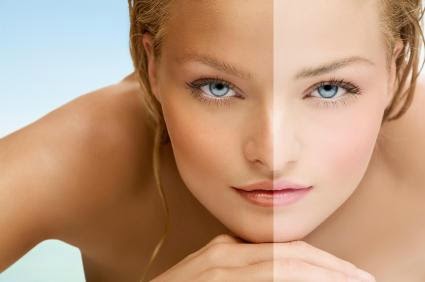
Generally I don’t tan outside or use tanning beds. I have, however, tried self-tanning creams. The only problem is my enlarged pores usually become more obvious after putting the cream on.

Self-tanners have ingredients that essentially dye your skin. If you are experiencing an increase in the appearance of your pores after using a self-tanning cream, you may not be able to use one on your face. There aren’t any magic solutions. Perhaps you can experiment with different tanners and see if one of them doesn’t cause this problem. Some self-tanners have less dye and more ingredients that help stimulate the melanin in your skin to produce a tan. Maybe one of these would work for you. I commend you for using self-tanning products versus going to a tanning salon. That is a great choice!
You might want to try exfoliating your skin before applying the self-tanner. This way you will clean out your pores and lessen the potential for debris held inside to be dyed from the product.

HOT TIP: After spraying your face with toner, then apply your moisturizer. This way you get good spreadability as well as an even application.

For more information, see:

Tuesday, August 25, 2015

How and when to moisturize

I'm not a fan of the “dotting” method
How to moisturize. When applying moisturizer, you may put dots of cream on different parts of your face and then smooth them in. I propose an alternate way to apply your moisturizer. Although it’s a small change, it can make a big difference.

Put a peanut-sized dollop in the palm of one hand, then rub your hands together to emulsify and warm the cream. Smooth the cream over your entire face and neck using both your hands (palms), not just the tips of your fingers. Applying the moisturizer this way increases your chances of getting the cream on all parts of your face evenly. This is important. The connect-the-dot method can cause an uneven application; some areas will have a concentration of moisturizer while others will hardly have any.

If your nose tends to get oily during the day, bypass it when applying the cream. Just lightly go over the nose area as you finish smoothing the cream over your face and neck. This should help to keep the oily nose syndrome to a minimum. Also, if you have to pat off excess product from your face, you’ve used too much. Try using less cream to start with, then while your face is still wet from the toner, apply your moisturizer. This will help you achieve a thinner application.

When to moisturize. You always want to apply a moisturizer after cleansing and toning (Steps 1 & 2 of The Basics). You also want to use your hydrating cream(s) both in the morning and at night. Usually, moisturizer is the last product you put on your skin. If you are wearing foundation, it will go on top of your day cream. Applying eye cream is a continuation of Step 3.

For more information, see:

Sunday, August 23, 2015

Cellulite happens—how about a paradigm shift?!

If you don’t already have some cellulite, consider yourself lucky (or young). If you are a woman approaching your 40s who doesn’t have cellulite, you soon will. If you are one in a million, you might not, but most of us ladies (and some men, too) will see the ugly monster present itself at some point in our lives. Although men do develop cellulite on certain parts of their bodies, I think it is predominately a woman’s issue.

My feeling about this “malady” is really no different than how I feel about wrinkles and the aging process in general. Cellulite isn’t the end of the world, it is just your body going through the motions of aging and storing fat. It’s doubtful you can get rid of cellulite completely, even with expensive procedures; in time the cellulite will most likely return.

I doubt my point of view will make you feel any better, but it is an attitude that I have decided to adopt, knowing there isn’t a lot I can do about cellulite. Honestly, I just don’t let it bother me. It’s everybody else’s problem to deal with, not mine. And I actually mean that! With that said, I don’t love the cellulite that has somewhat taken over my body since walking through the gates into menopause. The dimpling had definitely gotten more widespread with the changing of my hormones, but still I persist in not letting it get me down. I don’t, however, wear short skirts or short shorts anymore!

Are you judging yourself based on how you judge others? Do you look at someone with cellulite and say “Ick,” or “That is so ugly”? If so, then naturally when it comes to your own possession of this fatty substance, you are going to frame it the very same way. How about a paradigm shift? Stop judging others’ cellulite and ease up on your own self-judgment too. If you try on this new attitude for a change, you may start feeling differently about cellulite.

For the last several years I have been down for the count with adrenal exhaustion. Not fatigue—exhaustion. Gone were my hiking days (boo!) and also gone was the energy to simply do the basic tasks that were needed in my day. And so, too, the cellulite on my body grew. It’s everywhere now, not just on the backs of my legs, and I still maintain the attitude of, “Oh, well.” One day I’ll be able to exercise again but doubtful will I really be able to rid my body of the cellulite I have accumulated since my hormones went through “the change.” And that’s OK!

If you have a lot of cellulite and you are out of shape, guess what? Maybe it’s time to put things into perspective. You either need to get moving, get your muscles in shape, and burn some of your stored fat (aka cellulite), or you need to remember that the fat you see as cellulite is just your body showing you the fruits of your labor, or in this case, the possible fatty deposits of your non-exercising ways. Fat is stored (deposited) in the body to be used for energy at a later date. If you are not pushing your body to consume more energy, fat will accumulate. This is not to ignore those of us who have a genetic tendency to get cellulite, but in general keeping your body active and the calories burning can help keep fat from depositing.

Not everyone can be active and exercise to increase the mobility of his or her body. I realize some of you may have injuries you cannot overcome or are disabled in some way that decreases your ability to move. I am speaking to the majority of you who can exercise but don’t. Or maybe you do exercise, but you also eat a diet laden with poor-quality foods. Finally, you may exercise rigorously, eat a low-fat, high-quality diet, and still be genetically predisposed to having cellulite. My condolences to all of us who fit under that category! Rather than give a diatribe on exercising or diet, what I really want to say is that cellulite is here to stay, and there isn’t a lot you can do about it. But be my guest: go and spend hundreds if not thousands of your hard-earned dollars trying to get rid of that dimpled fat.

It’s not unlike wrinkles: no matter how hard you try to get rid of them, they will find a way to make their presence known. You can fight and be defiant in your resistance, but somewhere along the way I hope you will ease up on your fight against cellulite (or aging) and turn your attention to helping your body become healthy and balanced from the inside out. The “out” may never be void of cottage cheesy-looking thighs, but if you are living a good life and enjoying it to the fullest, my hope is that those minor inconveniences will just pass in and out of your mind without stopping to be refueled. I’m hoping you will find a way to just let it go, to try and get over it and be happy!

As you are walking around, you cannot see your cellulite; it’s other people who can. So let them bear the responsibility of liking it or not. Who cares what they think, anyway? If they are strangers, so what? And if they are your family or friends who love you, they love you, cellulite and all. Perhaps you have a friend or husband or mother who chides you about your cellulite. Create a good comeback for their insensitive comments and know you are doing the best you can to have a healthy body and a healthy outlook on life, cellulite included.

Choose your battles. Is this one a worthy choice or could your time and energy be better spent pursuing more attainable goals? Maybe instead of seeking to eliminate the monster cellulite, could you settle for committing to a regular exercise program? Even if all it involves is walking—every day. Exercise is important and there are books, videos, and vast numbers of people who can help you put together a healthy routine to keep your body in good shape.

For most of us, cellulite is going to happen at some point—especially as we get older and especially if we gain weight and get overly fat. If you choose to spend your life trying to get rid of cellulite, I truly believe you are fighting a losing battle.

For more information, see:

Friday, August 21, 2015

A teenager’s skin care routine & questions + a few suggestions

The following email is from my niece, Nicole. She was 14 when she wrote this, and I think she exemplifies a lot of teenage girls and their quest to learn about skin care. She did have a skin care routine, but didn’t have a lot of guidance as to what to use other than from magazine ads and TV commercials. Here is her email, with her teenage humor intact.

So about my skin, it is pretty good. It’s normal and “well.” The only places that I have problems and have to watch are around the creases of my nose and the “middle line” on my chin. My forehead isn’t really a problem, and my skin is all around okay.

I wash both morning and night with Oxy Balance® Deep Penetrating Facial Cleansing Wash that contains 2% salicylic acid. It is a gel cleanser and it works pretty well. I also use a Clearasil® Stay Clear Zone Control Clear Stick. It also has 2% salicylic acid. Now that I am thinking, the rest of the ingredients (which aren’t on the package) are probably just alcohol, which is really cute.*
*These exact products are no longer available. They have morphed into new and slightly different salicylic acid and benzoyl peroxide products.

So if anything I am doing is like horrible, or if you have any suggestions I would love it, because my system is of my own making, and I know that a little advice could probably go a long way.

Oh yeah, I do use a fruit scrub from Origins®, and I really like it. I also use a charcoal and white China clay mask, which I also like. If you have any ideas I would welcome them with open pores. (Ha ha.)

Nicole’s program is pretty typical for a teenager. She is probably getting most, if not all of her skin care information from TV and magazines. Neither one will give her much more than product marketing with a lot of advertising dollars behind them.

She seems to have a really good routine, probably better than some adults I know! She washes morning and night and uses exfoliators and clay masks. Overall she seems to have done a really good job of divining her own system, and as long as her skin stays clear, she can continue using what she’s using.

Although some of the products may be drying out her skin (especially those containing benzoyl peroxide), it doesn’t seem to be bothering her at the moment. My advice would be to monitor the situation, and if she starts to develop problems with her skin, I would get her on some better products that don’t contain drying ingredients. Knowing the pH of products is important and can help keep the drying out process from happening.

Of course diet is also going to play a key role in Nicole’s skin. Maybe not now, but at some point. As a teenager I had a horrible diet filled with sugar galore, and I had great skin until I turned 21. Then everything caught up with me, and I developed true acne. To tell a teenager not to eat sugar and other junk food is sort of ludicrous, but do watch the intake of certain foods if problems start occurring with your skin. Otherwise, enjoy your teen years!

For more information, see: