
.

Showing posts with label sunless tanning. Show all posts
Showing posts with label sunless tanning. Show all posts
Friday, June 5, 2020
Thursday, August 27, 2015
More questions about Enlarged Pores

Enlarged
pores are one thing, clogged pores are another. The question you need
to ask yourself is: are your pores just enlarged with no congestion, or
are they filled with debris? Debris means anything that may be nestled
in the pore, which could be oil and dead skin or environmental debris
from the air. Congestion, therefore, is stuff (debris) clogging your
pores.
There
isn’t much you can do about the enlargement that has already occurred.
Once the pore is stretched, it can’t shrink down to a smaller size.
However, using appropriate moisturizers can help cut down on future
enlargement. If you are using a moisturizer, oil-free or not, that is
too much for your pores to handle, you could cause enlargement to occur.
If
your pores are clogged, it will determine what type of moisturizer you
will use, or rather what type of skin the moisturizer should be for
(oily and possibly problem). But to forgo lotion altogether is a
mistake. You want to use moisturizer, just be sure it is appropriate for
your particular skin type.
If
shininess is a problem due to oily skin, you want to avoid lotions that
employ mineral oil or petroleum as ingredients. These will simply add
to your already oily skin and could be the reason for your
self-described shininess. In general, oil isn’t bad as an ingredient,
but petroleum-based oils are not desirable. Due to their occlusive
(heavy) nature, they don’t absorb into the skin and therefore just sit
on top causing your skin to look shiny and even causing the potential
for enlargement of your pores. Search for a moisturizer that has vegetal
oil or nut oils. These will add moisture to your skin without creating
an oil slick on your face.
 |
| Don't use too much cream! |
Generally
I don’t tan outside or use tanning beds. I have, however, tried
self-tanning creams. The only problem is my enlarged pores usually
become more obvious after putting the cream on.
Self-tanners
have ingredients that essentially dye your skin. If you are
experiencing an increase in the appearance of your pores after using a
self-tanning cream, you may not be able to use one on your face. There
aren’t any magic solutions. Perhaps you can experiment with different
tanners and see if one of them doesn’t cause this problem. Some
self-tanners have less dye and more ingredients that help stimulate the
melanin in your skin to produce a tan. Maybe one of these would work for
you. I commend you for using self-tanning products versus going to a
tanning salon. That is a great choice!
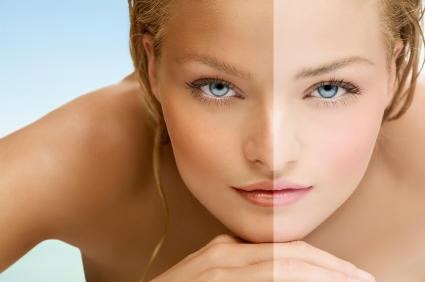
HOT TIP: After spraying your face with toner, then apply your moisturizer. This way you get good spreadability as well as an even application.
For more information, see:


Tuesday, March 10, 2015
Sunless Tanning with a Cream

In mid-winter or even in summertime, some of us like to have that golden brown look of a suntan minus the sun. Obviously in winter your body isn’t exposed so there is no chance of tanning. And in the warmer months many of us simply don’t want to incur sun damage in order to be a bronzed beauty. There are, however, many ways to look like you have a tan all year-round.
One route to artificial color is a tan received in a tanning bed. Can I just say: Don’t do it! Another kind of artificial sun, which is perfectly safe, is achieved through the use of self-tanning creams. These are very prevalent on the market, so there are many products to choose from. They are a much better alternative than tanning beds or even natural sun exposure. Sunless tanning is a safe way to look like you have a tan without incurring any of the damage of a real suntan or from a tanning bed. When using self-tanning products, you’ll want to follow a few simple instructions.
One route to artificial color is a tan received in a tanning bed. Can I just say: Don’t do it! Another kind of artificial sun, which is perfectly safe, is achieved through the use of self-tanning creams. These are very prevalent on the market, so there are many products to choose from. They are a much better alternative than tanning beds or even natural sun exposure. Sunless tanning is a safe way to look like you have a tan without incurring any of the damage of a real suntan or from a tanning bed. When using self-tanning products, you’ll want to follow a few simple instructions.
- Exfoliate all areas of your face and body where you will be applying the product for the best results. Most self-tanners employ an ingredient called dihydroxyacetone, which is essentially a skin dye. You want to get rid of any dead skin buildup so your tanning product will have a better chance of going on smoothly and staying on longer.
 Shave your legs, ladies, before applying self-tanner. Otherwise some of the dyed skin may come off if you shave shortly afterwards.
- Apply your self-tanning cream evenly as best you can. This can be a challenge because you really won’t know if you have spread it evenly until much later. It goes on as a clear or white cream (or oil) and once it is absorbed into the skin, it disappears like a moisturizer. It’s not until several hours later that the color begins to appear. Spread it onto small areas so you can keep track of where you’ve applied it and where you haven’t.
- Wash your hands thoroughly and immediately after application. If you ever forget this one step, I guarantee you won’t forget it a second time! It’s pretty embarrassing to be walking around with the palms of your hands and the skin around your nails stained brown. It’s very hard to get this discoloration off your hands.

- In order to avoid dying your hands you can wear disposable gloves. However, unless they fit your hands really well (and are tight) the gloves could cause you to apply the self-tanning cream unevenly. I prefer using my hands and, therefore, getting a smooth application. I’m just careful to thoroughly wash my hands immediately afterwards.
- Let the tanning cream dry on your skin before getting dressed. Otherwise there is no telling what your tan will look like, to say nothing about what could happen to your clothes. Remember, these creams are basically dyes.
Sunless tanning usually lasts two to three days. After that, you’ll need to reapply. Some people experience streaking or blotchiness. This can be the result of a poor-quality product, or the product might have been applied improperly. You may have even applied it too often over several consecutive days.
You may come across a self-tanning cream that just smells bad—like burned skin. This is unfortunate, but it does happen with some products. Obviously, don’t use that particular brand again, and perhaps get a product referral from a friend who uses sunless tanning products.
There are many self-tanning products available, so you’ll have a lot of options. There are sunless tanning creams, oils, and even self-tanners in a spray bottle. Whichever method you choose, don’t forget to follow the steps listed above, and you can enjoy year-round color without receiving any of the sun damage of a real tan.
For more information, see:

For more information, see:
- Do sunless tanning creams really work?
- The BEST Self-Tanner! Lait Auto-Bronzant
- Imitation Sun aka tanning beds—Costly UV
Wednesday, March 14, 2012
Do sunless tanning creams really work?

During these warm to hot days, I prefer to have a bit of color on my legs vs. facing the world with these 2 white sticks! This is where self-tanners come into play. Of course I use Yonka’s sunless tanning products, and my absolute favorite is Lait Auto-Bronzant.
No matter which self-tanning product you use, here are some guidelines to follow that will hopefully help you get a good-looking fake tan without incurring the added sun damage of a real tan.
- I like to apply the tanning product right after a shower. I always use a body lotion after baths and showers (to help keep my body skin soft), so I just substitute the self-tanner for my normal lotion.
- When using a self-tanner, you do need to be careful where you apply it as well as making sure you get it on evenly to avoid blotchiness. Watch out for bony areas like ankles, elbows, and wrists. These places can appear darker if you apply too much product.
- After applying, it is best to not put on clothing for a little while. I like to give the product at least 10-15 minutes to soak in. Otherwise you run the risk of it coming off on your clothes and getting uneven color on your skin.

I do this process 2 days in a row. Why? I have found one day is not enough and 3 days in a row is too much—the color starts to look self-tannery (aka fake). Then I’ll wait 3-4 days before reapplying. This schedule seems to work best for me and my coloring. You may need different timing depending on your skin tone.
I personally never apply self-tanners to my face, but you absolutely can. For me, since I don’t wear any makeup, it feels—well, like I have put makeup on. So I just go with the natural coloring of my face. There really isn’t anywhere you can’t apply this type of product.

Being the eternal experimenter, I wanted to see how well the Auto-Bronzant worked, so I put it on one leg only over 2 days (two applications). It warmed up in Chicago and my now ex-boyfriend and I went to play golf. Of course I was wearing shorts.
While we were walking to the clubhouse, I got ahead of him. The next thing I heard was, “What is going on with your legs?! They are different colors!” Oppsie.
I had to laugh. I had completely forgotten about my self-tanner experiment! The good news is my “tan” leg looked great—very naturally tanned. The other leg got a tan right after my golf game—but beforehand it really did look lily white from a long Chicagoland winter!
For more information, see:
- Sunless Tanning with a Cream (for more detailed instructions on applying self tanners)
- Yonka’s Prolongateur de Bronzage—tan prolonger
- The BEST Self-Tanner! Lait Auto-Bronzant

Subscribe to:
Posts (Atom)