.

.

Monday, April 11, 2016

More Questions about Hyperpigmentation

This young lady really just has freckles, not true hyperpigmention. Love your freckles!
I am concerned because I spent a lot of time in the sun when I was younger playing tennis, swimming, and running. As a result, I have brown spots. So what do I do now?

My question to this person would be are you still an active, outdoorsytype person? If the answer is yes, you can spend a lot of money trying to erase the spots you have accumulated from the past, but as long as you are still in the sun to a large (or even a small) degree, the brown spots are going to keep occurring. If you have them now, you are prone to getting them. If you are susceptible now, you probably will be for the rest of your life. Rather than viewing this as a life sentence of irregular pigmentation, accept it as simply a fact and a reality in your life.

If you’ve read any of my articles on hyperpigmentation, you will know that avoiding direct sunlight is going to be your biggest help in stopping the brown spots from occurring in the first place as well as helping lighten the darkness you already have incurred. Several of the newer laser technologies have had good results with existing pigmentation irregularities. But please know that you truly control this situation by controlling the amount of direct sunlight that reaches your face. You probably were not aware of this in the past, but by using this knowledge going forward, you can help the dark spots to fade over time.

I break out and also have dark spots on my skin that I would love to try to lighten. Is there a product I could use for that?

There are several products out on the market that say they lighten pigmentation. Some are actually bleaching creams, and others inhibit melanin production. Many of the creams to reduce pigmentation also contain glycolic acid or even retinol. To any of you who have redness in your skin like couperose and especially rosacea, I caution you against using these types of creams. I see redness worsen when using AHAs (glycolic is an AHA) or retoinoids. Don’t take care of one thing, like hyperpigmentation, and cause another, like redness or couperose.

Even if you successfully use one of these bleaching or melanin inhibiting creams, you still have to be ultra-sensitive to how much sun exposure you are getting. No matter how light your spots get, if you are prone to hyperpigmentation, then you are prone to hyperpigmentation. Lightening the dark spots does not change this tendency.

It’s a drag I know because I have hyperpigmentation. When I was in my early 30s, my fluctuating hormones created for the first time in my life dark spots, sometimes called chloasma, melasma, or hyperpigmentation. Whatever you want to call it, I had dark patches all over my face—mostly on my cheeks and forehead. Now in my 50s, things have not changed; I am still susceptible to darkness unless I am ultra-careful not to get direct sunlight on my face. I wear a water-resistant sunscreen whenever I am out exercising (or in the sun for whatever reason), and still if I’m not careful, I’ll get the dark spots.

If the pigmentation spots this emailer is inquiring about are due to her breakouts, this could be a condition called post-inflammatory hyperpigmentation.

For more information, see:

Saturday, April 9, 2016

Yonka Products for Oily Skin

I wanted to post some information to help you put together a skin care program using Yonka products if you have oily skin.

Click on any product name to be taken to its corresponding article on this blog. 

You first need to determine the amount of oil your skin produces to truly understand which products to use. Please read:


I have an oily t-zone with normal (or dehydrated) cheeks:


I have a lot of whiteheads:


I have a lot of blackheads, but no breakout:


I have dry, flaky skin, but it's oily too:


I have very sensitive skin that is also oily:


Here are all the links from above:

For a few more helpful articles pertaining to Yonka products, see:

If you havent already, please read the following for more helpful information:

Thursday, April 7, 2016

Teenage Skin Problems Q & As

Sometimes it seems a cruel joke is being played on teenagers. They’re at an age when they want to fit in, they want to look good, and coincidentally, it’s the time when their hormones are first starting to activate. It’s also a time they’re getting their first glimpse of freedom. They’re learning to drive a car and hanging out with friends after school. This freedom may also lead to poor eating habitsfast food, sugary foods, sodas and the like. Raging hormones, sugary snacks, and junk food are a recipe for potential skin trouble. However, your teen may have really good eating habits, yet still battle skin problems.

Although the following questions may be about a young female or male teenager, the answers apply to either gender.

My teenager is starting to break out. Is he too young to get a facial?

I do think its a great idea to take your teenager in for a facial. Here you will get expertise and advice from an aesthetician who has presumably worked with skin and knows how to guide your teen into better skin care habits. As long as your teen is having problems with his or her skin, a facial can definitely help.

As I tell any client, facials are beneficial on several levels and can indeed help with problems. But what’s most important is how you are taking care of your skin on a daily basis at home. The Basics 1-2-3 (cleansing, toning, and moisturizing) done on a twice daily basis, plus The Extras (exfoliating and using a clay mask), which can be done once to several times per week, can simulate some of the effects of a professional facial. 

My teenage son is developing acne. What should I do?

This is a tough one. During puberty, a young person’s skin can go absolutely haywire. And these skin problems may not be solely due to hormones. Does your teenager have a “clean” diet, or does he tend to eat fast food, sweets, and sodas laced with sugar or sugar substitutes? In my practice, I have found sugar to be a leading cause of problem skin. You said your son is developing acne. Although he is in the most difficult place (being a teenager) for his skin to clear up, you still have a few options to choose from.

You could do nothing. Obviously, this is not what you will do. But the truth is that as long as his hormones are in this super-active phase and if he does in fact have poor eating habits, your son’s skin will more than likely continue to be problematic. If you choose to go to a dermatologist, he or she may put him on antibiotics, or possibly Accutane. That is up to the doctor and his or her assessment of your child’s skin condition.

Tetracycline is an antibiotic that is commonly used to treat acne. It does not have the same side effects as Accutane, and may get your son’s acne cleared up, but maybe not. Accutane would be the last resort as far as I’m concerned because there are so many side effects. Taking Accutane might initially help clear up your son’s acne, but if he eats a poor-quality diet, and as long as his hormones are out of whack, the medication might just be a temporary fix.  However, some people (both teenagers and adults) have gone on Accutane and had their skin problems clear up—for good.

Another option is to try topical medications like Retin-A, a prescription topical retinoid cream, which may be effective on your son’s acne. Depending on what your dermatologist recommends, I would start with topical treatments, and see if your son can find some relief from his acne.

If your son does eat junk food and things that contain a lot of sugar, I highly recommend evaluating his diet, and see if you can encourage him to stay away from these problem-producing foods. If he will drink a lot of water, along with using skin products that will help promote a more bacteria-free environment, hopefully he will see improvement in his skin. I would go this route first (the dietary one) and see how it goes. If all else fails, there are always drugs he can take or apply topically, but they do have their individual side effects along with their ability to possibly help clear his skin up.

If you havent read them yet, I highly recommend the following articles:  
If youve lucked out and your teen isnt having any skin issues yet you want to start them on a simple routine, see:

Sunday, April 3, 2016

Yonka-Paris SPF 50: UVA/UVB Sunscreen

Yonka has discontinued SPF 25 (as well as SPF 20). This article was originally about both SPFs 25 & 50, so I have removed all the information for SPF 25. If you want to read about that product or any other that has seen its last days, go to the discontinued products category (link below).

Back in 2012, Yonka revamped several of their products while redressing the line with new packaging. Some of those products that went through an overhaul were their sun products. And if I can say sothankfully! Except in the case of the now discontinued Lait Solaire (Oh, how I loved that product!), the former Ultra Protection SPF 25 and SPF 40 sunscreens contained so much titanium dioxide that many of my clients couldnt use these sun products because it made their faces so white, with the titanium dioxide never really absorbing in. Not so with this SPF 50 sun product. It is quickly and easily absorbed while providing excellent sun protection.

SPF 50 is a medium-textured moisturizer with SPF 50. This product replaces YonkaSPF 40 Cream. It is perfect for all skin types and can also be used on your entire body to help stop sunburn. As with any and all sun products, if you are going to be exposed for extended periods of time, REAPPLY! 

SPF 50 does contain titanium dioxide as one of its main sunscreen ingredients. For some people, titanium dioxide, a white somewhat chalky substance, can leave the skin looking a bit white after initial application. Given a few minutes, this effect usually fades as the cream absorbs into the skin.
 Previous Yonka sunscreens (Ultra Protection and SPF 40) did not absorb into the skin as well as this new edition does. Sodont fearSPF 50 does not leave a white, chalky film on the skin. It absorbs quickly and easily and generally does not leave the white tell-tale signs of sunscreen application like the older versions of these creams did.

SPF 50 is broad spectrum sun protection. You always want to use a sunscreen that is termed full or broad spectrum, which means it protects against both UVA and UVB rays. Most sunscreens on the market now have both UV filters in them (this used to not be the case). Without protecting your skin from both kinds of UV rays, a sunscreen is only doing half its job.

Essential ingredients:
  • Apricot kernel oil, vegetable glycerinhydrating, revitalizing, regenerating, nourishing
  • Bisabolol, vitamin B5, licorice extractsoothing, softening, anti-inflammatory
  • Vitamin E, three teas polyphenolsvitamin Aantioxidant, protects against free-radical damage, regenerating, anti-inflammatory
  • Active Sunscreen Ingredients:
    • Titanium Dioxide 11%
    • Octocrylene (8%)
    • Octinoxate 7.5%
    • Oxybenzone (5%)
    • Octyl Salicylate 5%
    • Homosalate 4%
    • Avobenzone (3%)
    • Ensulizole (3%) 
Directions for use:
  • Apply generously before any exposure
  • Reapply at least every 2 hours and after swimming or sweating
  • Concentrate on the areas that are particularly sensitive or are exposed to sunnose, tops of the ears, and shoulders, for instance

If you’re going to be exercising outside, use a waterproof product. If you’re only going to get incidental sun (like to and from your car), a regular, non-waterproof sunscreen will usually be enough.

For more information on protecting your skin in the sun, see:

Friday, April 1, 2016

From Ballet to Beauty—About Carolyn Ash

A passion for health, healing, and the human body led Carolyn Ash to a career as an aesthetician and a renowned skin care specialistbut her unique understanding of skin and the body can be traced to her years as a ballet dancer.

Me, age 12
A dancer since the age of four, Ash studied on a Ford Foundation scholarship at Balanchines School of American Ballet (SAB) in New York City before injuries forced her to give up dancing. Yet it is her experience as a dancer that is what she attributes to her unique insight about the connection between mind, body, and spirit.

“Ballet dancing really puts you in-tune with your body like nothing else can,” says Ash. “Through dancing I learned to appreciate the key role that diet and exercise play in determining how we look and feel.


At age 23, Ash decided to follow her avid interest in health and healing and moved to Dallas to attend skin care school. In 1986, when the Hotel Crescent Court in Dallas decided to open a spa, Ash was hired as a facialist and massage therapist.


While at the world famous Spa at the Crescent, her talent as an aesthetician quickly became recognized. In 1986 and 87 she received the distinction of “Best Facial in Dallas” by D Magazine and “Best Facial” by W Magazine. Celebrities such as Kim Alexis, musician Lisa Loeb, and journalist Robin Leach also discovered Ashs talents as a skin care expert and many celebrities have continued to seek her advice over the years.

In 1990, Carolyn left Dallas to live in Los Angeles, working for yet another renowned spa at The Biltmore Hotel in Beverly Hills, as well as Dr. Harold Murad
s A Sense of Self Day Spa in Brentwood, California (no longer in business under this name).

After two years in L.A., Ash returned to The Spa at the Crescent to share her new knowledge with her Dallas clientele. Then in 1994, she fulfilled her long-time dream of opening her own skin care center, Carolyn Ash Skin Care, which was located in the prestigious Highland Park neighborhood in Dallas.


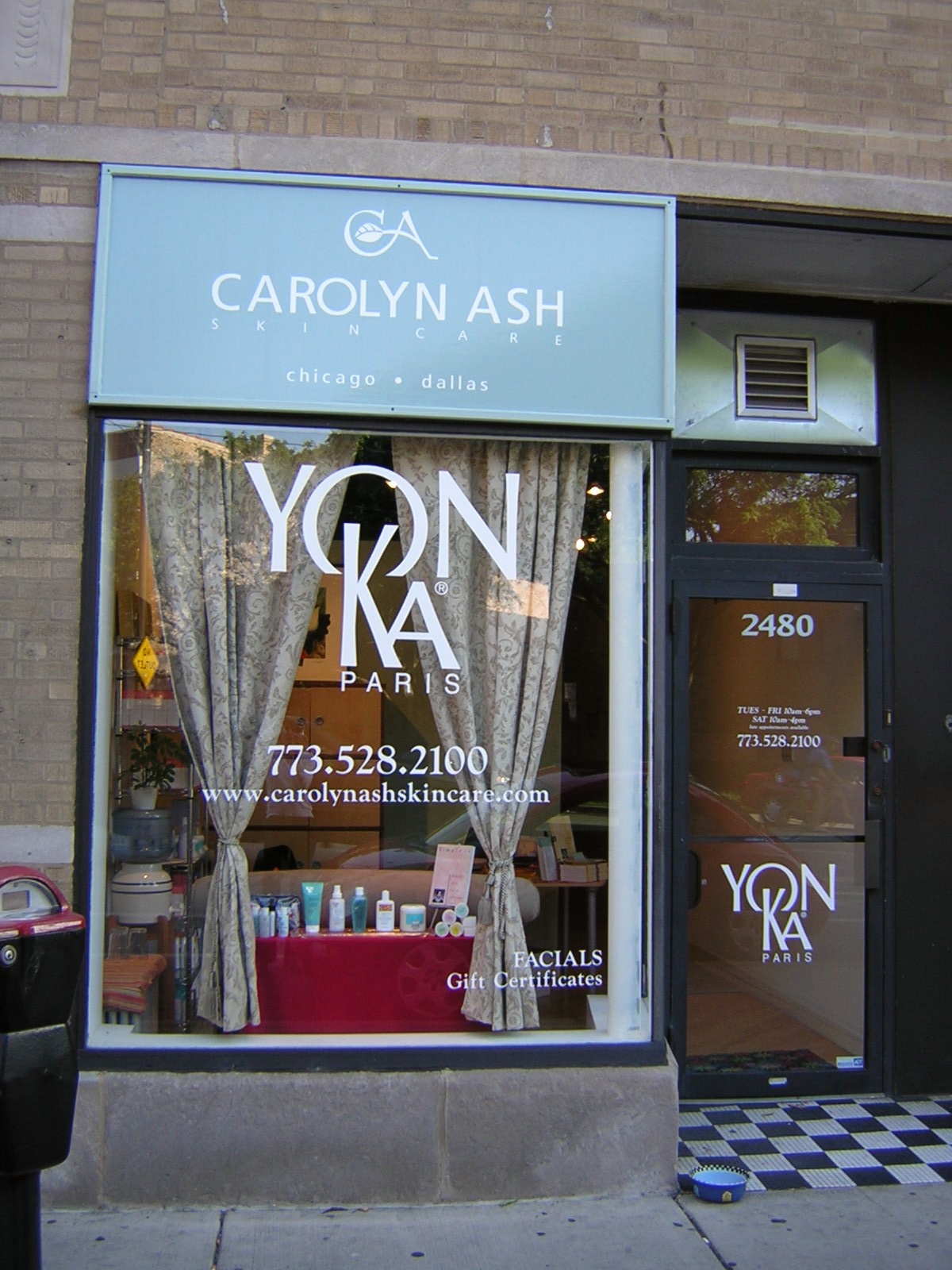
In 2002 Carolyn moved to Chicago and opened a successful storefront salon on Lincoln Avenue in Lincoln Park. Then in 2007 she moved to the state she grew up in, Colorado, where she currently has a salon in the wonderful front range town of Boulder. Since opening her salons, she has built a clientele that includes people from all over the country. Based on her experience with literally thousands of clients, she was inspired to write about how to have and maintain healthy skin.
(I closed my Boulder salon after 10 years in Colorado in 2017 and retired from my 33 year skin care career May 2018)

“I wrote Timeless Skin and Skin Care A to Z because I believe people want to be told the truth,” says Ash. “I wanted to dispel the myths and falsehoods floating around about skin care and instead offer sound advice to help people maintain healthy skin...for a lifetime. It all comes down to following a simple skin care routine, protecting your skin from sun exposure, and finding ways to balance the stress in your life.


“We are all concerned about aging. But aging is a natural processone that we should embrace not run from. Accepting this inevitable process, acknowledging your inner beauty, and realizing that The Fountain of Youth is found within, is what aging gracefully is all about.

For more information, see: